

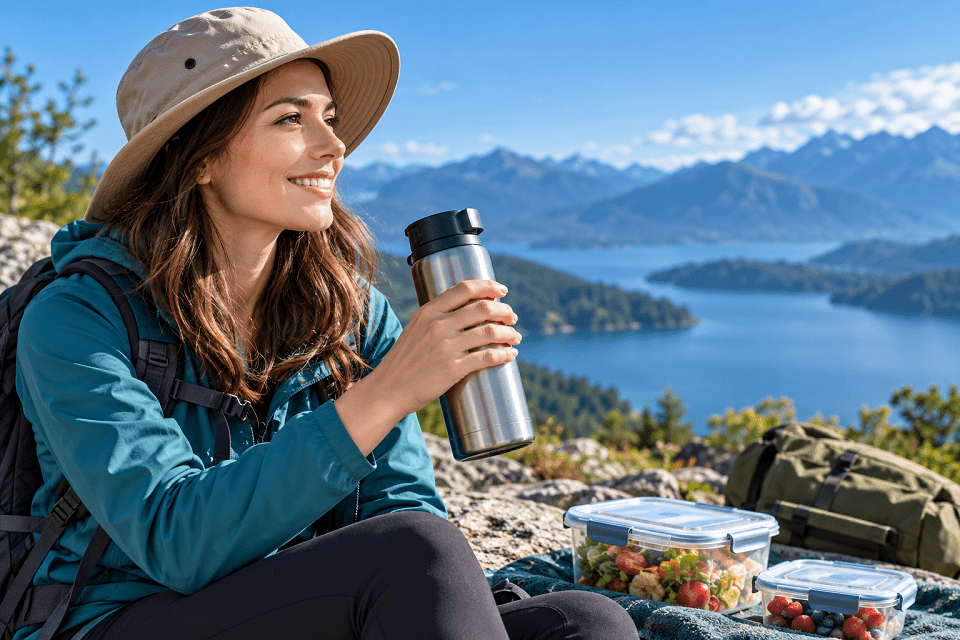
A day outdoors can quickly become less enjoyable when food gets warm, drinks lose their desired temperature, or fresh ingredients need to be thrown away. The right food-storage accessories can help maintain temperature and freshness during a picnic, hike, camping trip or long journey. The main options are a thermos, thermo-box, ice box and cooling elements. Each is designed for a different purpose, so the best choice depends on how much food you need to carry, how long it must remain at the desired temperature and how far you need to transport it.
Thermos: for drinks and prepared food
A thermos is designed to keep its contents hot or cold for an extended period. Its insulated construction reduces heat exchange between the contents and the surrounding environment. Typical capacities range from around 0.35 to 1.5 litres, although larger models are also available.
For drinks, a 0.5–1 litre thermos is usually sufficient for one person. Depending on the construction, filling temperature and ambient conditions, many models can maintain a useful temperature for approximately 6–12 hours. Food thermoses generally have a wider opening, making them more suitable for soups, stews, porridge and other prepared meals.
A thermos is particularly practical when you want individual portions rather than a container for a complete meal. For example, coffee or tea can be prepared before leaving home, while a food thermos can carry a hot lunch for a workday outdoors or a winter walk.
When comparing models, check the manufacturer’s stated heat-retention time rather than relying only on the phrase “double-wall insulation”. Capacity, lid design and the quality of the vacuum insulation all affect performance.
Thermo box: for carrying several portions
A thermo box is an insulated food container designed to hold a larger quantity of food than a typical thermos. Capacities commonly range from approximately 5 to 30 litres, with larger versions available for group use.
Unlike a thermos, a thermo box is generally intended for multiple containers, ingredients or prepared dishes. Its main function is to slow the transfer of heat rather than actively cool its contents. Depending on insulation thickness, how full the box is and the ambient temperature, it may keep food cool for several hours. Cooling elements can be added to extend this period.
A 10–15 litre thermo box can be suitable for a picnic or day trip for several people. Larger models can be useful when camping or transporting a greater quantity of fresh food. The rectangular shape also makes it easier to organise food containers than a conventional bag.
Weight and dimensions matter here. A well-insulated box may provide better temperature stability but can be inconvenient if it needs to be carried over a long distance.
Ice box: when cooling capacity is the priority
An ice box is another insulated container, but the term generally refers to a container designed specifically for keeping food and drinks cold. Ice or frozen cooling elements are normally used inside it. In everyday use, “ice box” and “cooler” can refer to similar products.
The main difference from a thermo box is the intended temperature-control method. A thermo-box can be used simply as an insulated container, while an ice box is normally paired with ice or frozen packs to maintain a low temperature.
Typical capacities range from around 10 to 50 litres, with compact and much larger models available. Cooling time can vary substantially: a well-insulated ice box with sufficient ice may keep contents cold for 12–24 hours or longer, while a lightweight container exposed to direct sunlight may perform for considerably less time.
For a short picnic, a 10–20 litre ice box may be enough. For camping or a long car journey, a 30–50 litre model provides more capacity but also becomes heavier once filled. Drainage, lid construction, insulation thickness and the ability to secure the lid are useful factors to check.
Cooling elements: a simple way to extend cooling time
Cooling elements, or reusable ice packs, are designed to be frozen before use and placed alongside food inside an insulated container. They come in different shapes, sizes and filling materials.
Small packs are convenient for lunch bags, while larger packs are more appropriate for thermo-boxes and ice boxes. As a general starting point, cooling elements can account for approximately 10% of the container’s internal volume, although the required amount depends on the insulation, outside temperature and desired holding time.
For best results, freeze the elements completely before use and place them around the food rather than putting all of them on top. Pre-chilling the container and its contents can also reduce the initial temperature increase. Keep the container closed as much as possible, since every opening allows warm air to enter.
Cooling elements are reusable and do not create melted water inside the container, which can make them more convenient than loose ice. However, they occupy some of the available storage space and need access to a freezer between trips.
At a glance
| Option | Typical capacity | Temperature retention | Most suitable for |
| Thermos | 0.35–1.5 L | 6–12 hours | Individual drinks and meals |
| Thermo box | 5–30 L | Several hours | Picnics and day trips |
| Ice box | 10–50 L | 12–24+ hours* | Camping and longer journeys |
| Cooling elements | Varies | Extends cooling time | Use with insulated containers |
*Actual performance depends on insulation, the amount of ice or cooling elements, how often the container is opened and ambient temperature.
How to choose the right accessory
Start with volume. For one person, a 0.5–1 litre thermos may be sufficient for drinks or a meal. A 10–15 litre insulated container is more suitable for several portions, while 30 litres or more may be useful for group trips.
Consider the required holding time. If food only needs to remain at temperature for two or three hours, heavy insulation may be unnecessary. For a full day outdoors, look for products with published retention figures and consider using cooling elements.
Think about transport. A 20-litre box can become surprisingly heavy when filled with food and cooling packs. A smaller soft-sided insulated bag may be more practical for walking, while a rigid box is often easier to organise in a car.
Check the seal and construction. A secure lid helps reduce heat exchange and prevents accidental spills. For cold storage, insulation thickness is important, while a robust exterior can be useful for camping and transport.
Match the cooling elements to the container. Packs should be distributed around the food rather than concentrated in one area. As a starting point, around 10% of the container’s volume can be allocated to cooling elements, with adjustments based on conditions.
Choosing by scenario
For a short individual outing, a thermos is usually the simplest solution. For a picnic with several people, a thermo-box provides more space for prepared food and can be combined with reusable cooling elements. For camping, long car journeys or situations where food must remain cold for most of a day, an ice box with sufficient frozen packs or ice is more appropriate.
The key is not to choose the largest or most heavily insulated product automatically. Instead, consider the required volume, temperature-retention time and how the container will be transported. Matching those three factors to the actual outing usually results in a more practical setup and avoids carrying unnecessary weight.
Keeping food fresh outdoors requires the right equipment. We look at thermoses, thermo-boxes, ice boxes and cooling elements, covering different use scenarios and key selection criteria, including capacity, temperature-retention time and portability. A comparison table and practical tips will help you choose the right option for a picnic, day trip or camping trip.
